Bitcoin Rally Pauses as Derivatives Demand Cools

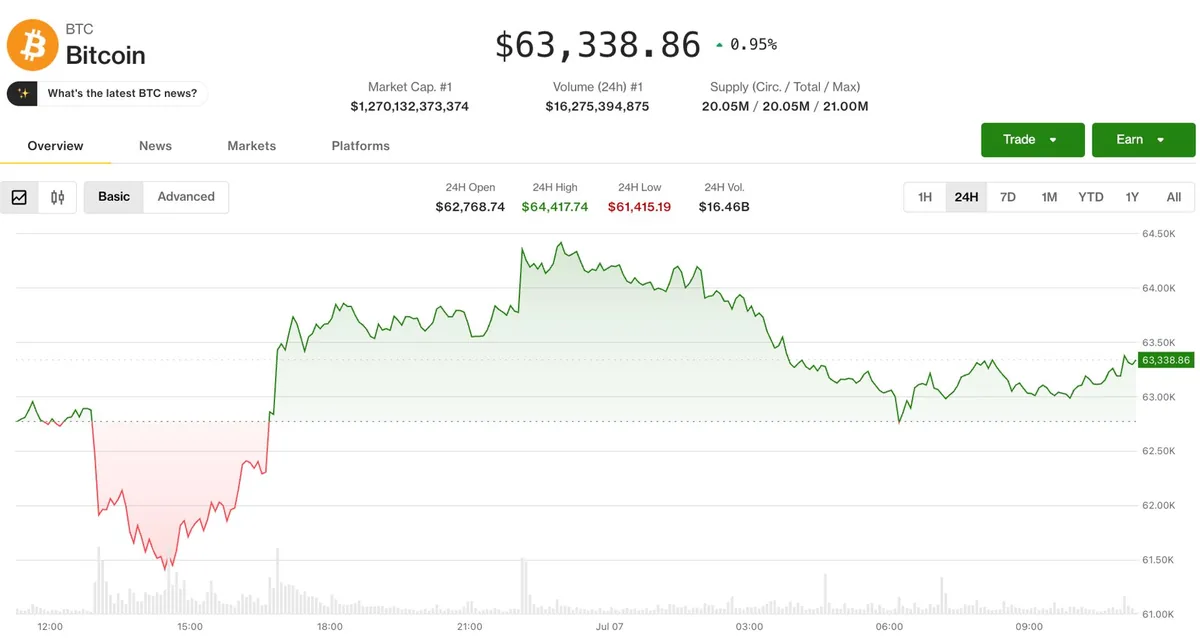
Bitcoin retreated after reaching a two-week high near $64,500, with falling futures open interest and weak spot-market signals raising questions about the strength of July’s rebound. The broader crypto market remains higher for the month, but positioning data suggests the move has leaned heavily on short liquidations rather than broad new demand.

Bitcoin Rally Pauses as Derivatives Demand Cools

What happened?

Bitcoin retreated after reaching a two-week high near $64,500, with falling futures open interest and weak spot-market signals raising questions about the strength of July’s rebound. The broader crypto market remains higher for the month, but positioning data suggests the move has leaned heavily on short liquidations rather than broad new demand.

Why it matters

The pause matters because the rebound has come with signs that traders are not adding leverage in step with rising prices. Bitcoin futures open interest fell to 740,000 BTC from a July 3 high of 776,000 BTC, while CoinDesk also pointed to weak ETF flows and a negative Coinbase premium as evidence that spot demand remains soft.

Bitcoin stalled on Tuesday after climbing to about $64,500 on Monday, its highest level in more than two weeks, according to CoinDesk. The pullback marked bitcoin’s first decline of the month and interrupted its longest winning streak since March, while ether also slipped after touching $1,830 the previous day.

The pause matters because the rebound has come with signs that traders are not adding leverage in step with rising prices. Bitcoin futures open interest fell to 740,000 BTC from a July 3 high of 776,000 BTC, while CoinDesk also pointed to weak ETF flows and a negative Coinbase premium as evidence that spot demand remains soft.

CoinDesk linked July’s recovery to a short-squeeze setup identified in late June, when bearish positioning was elevated even as bitcoin traded near its lowest level since 2024. More than $500 million in leveraged crypto futures positions were liquidated over 24 hours, with shorts accounting for most of the total for a sixth consecutive day.

The broader crypto market is still higher for the month, rising 8.4% since July 1 to a total value of $2.16 trillion. But derivatives data across major tokens showed a more cautious picture: ether’s open interest also weakened, and Solana’s open interest dropped to 68 million tokens from more than 76 million on June 24 despite a recent 10% price gain.

Altcoin performance remained uneven. ETHFI and LIT gained more than 30% over the past week, while FET, KASPA and WLD posted losses despite the broader market recovery. CoinDesk described that split as a sign of a more fragmented market, with token-level sentiment and onchain activity increasingly shaping performance rather than a uniform altcoin move.
Source: CoinDesk

Keep exploring

Related stories

Morning Minute: Strategy Turns Net Seller as Bitcoin Market Narratives Shift

Morning Minute: Strategy Turns Net Seller as Bitcoin Market Narratives Shift

Decrypt’s Morning Minute highlights three crypto market talking points: Michael Saylor becoming a major Bitcoin seller, a memecoin governance exploit, and Bernstein reiterating a $150,000 Bitcoin target. The developments point to renewed debate around corporate Bitcoin strategy, protocol governance, and bullish market forecasts.

Read
Reality Labs Losses Rise as Zuckerberg Calls Metaverse Push a ‘Pivotal Year’

Reality Labs Losses Rise as Zuckerberg Calls Metaverse Push a ‘Pivotal Year’

Meta’s Reality Labs reported $17.7 billion in operating losses last year, up 10% from the prior year. The unit’s total losses since 2020 have now exceeded $60 billion as Meta continues its metaverse buildout.

Read
Austin University Plans $5M Bitcoin Fund With Five-Year Holding Strategy

Austin University Plans $5M Bitcoin Fund With Five-Year Holding Strategy

Austin University is reportedly preparing to launch a $5 million Bitcoin fund as part of its endowment strategy. The fund is expected to hold Bitcoin for at least five years, reflecting a long-term view of the asset.

Read