Bitcoin Rises as Traders Rebuild Risk After Japan Rate Hike

Bitcoin moved above $66,500 after the Bank of Japan raised interest rates to a 31-year high, while several altcoins posted sharper gains. Derivatives data cited by CoinDesk showed rising volumes, open interest and short liquidations, pointing to a less fearful market tone.

Bitcoin Rises as Traders Rebuild Risk After Japan Rate Hike

What happened?

Bitcoin moved above $66,500 after the Bank of Japan raised interest rates to a 31-year high, while several altcoins posted sharper gains. Derivatives data cited by CoinDesk showed rising volumes, open interest and short liquidations, pointing to a less fearful market tone.

Why it matters

Several altcoins outpaced bitcoin. Stellar’s XLM, Injective’s INJ and Uniswap’s UNI advanced between 13% and 16%, ranking among the strongest performers in the top 100 cryptocurrencies by market capitalization. UNI’s gain followed Standard Chartered initiating coverage of Uniswap and setting a long-term price target of $100 for the token by 2030.

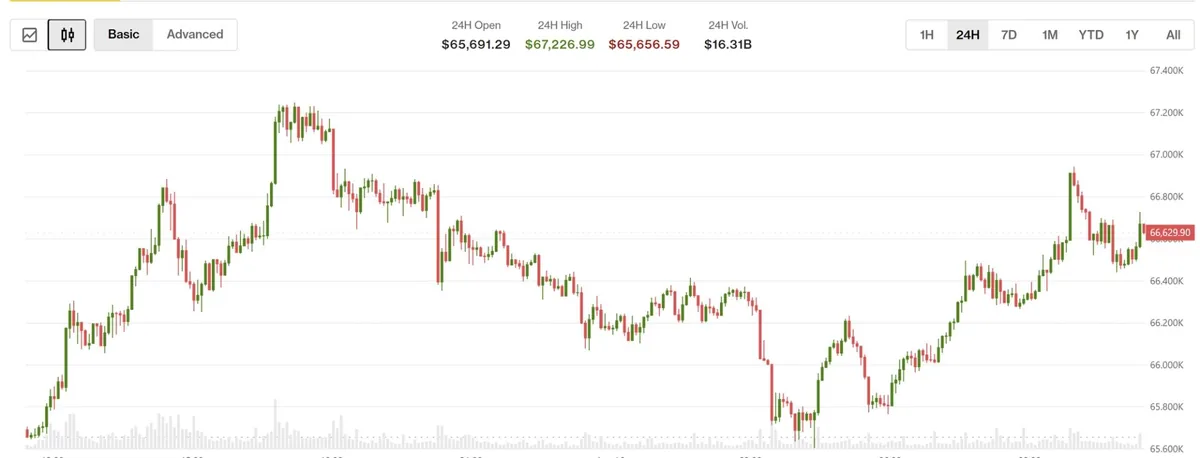
Bitcoin rose on Tuesday after the Bank of Japan lifted interest rates to a 31-year high, moving from about $65,600 during Asian trading to above $66,500 in European hours, according to CoinDesk. The largest cryptocurrency was up about 1.5% over 24 hours and continued its rebound from a June 5 low below $60,000.

The move matters because it came alongside signs that traders were becoming more willing to take risk again. CoinDesk reported that 24-hour crypto trading volume climbed 51% to $207 billion, total open interest rose 2.4% to $113.41 billion, and liquidations increased 64% to $561 million, with short positions making up most of the forced exits.

Several altcoins outpaced bitcoin. Stellar’s XLM, Injective’s INJ and Uniswap’s UNI advanced between 13% and 16%, ranking among the strongest performers in the top 100 cryptocurrencies by market capitalization. UNI’s gain followed Standard Chartered initiating coverage of Uniswap and setting a long-term price target of $100 for the token by 2030.

Positioning in derivatives also suggested a market recovering from earlier stress. Bitcoin futures open interest rose to 747,000 BTC, its third straight daily increase and the highest level since June 4, while ether futures open interest ticked up to 14.20 million ETH from a recent low of 13.64 million ETH. Funding rates near zero and a positive open-interest-adjusted cumulative volume delta pointed to a more balanced market rather than one driven by excessive leverage.

Not every token shared in the rebound. SIREN fell another 21% over 24 hours and was down 77% month to date, with blockchain data trackers on X pointing to a large holder offloading coins representing 92% of supply as the main driver of the decline. Avalanche also drew negative attention, as Santiment data cited by CoinDesk showed bearish commentary outnumbering bullish posts while traders debated whether Avalanche can keep pace with rivals such as Solana and Sui.

Source: CoinDesk

Keep exploring

Related stories

Two Weeks Left for Clarity in U.S. Crypto Policy Debate

Two Weeks Left for Clarity in U.S. Crypto Policy Debate

The latest State of Crypto update says the industry has two weeks left in the push for the Clarity effort. The development keeps attention on U.S. crypto policy as companies and market participants watch for regulatory direction.

Read
Sberbank plans crypto trading infrastructure launch by Dec. 1

Sberbank plans crypto trading infrastructure launch by Dec. 1

Russia’s biggest bank says it plans to create cryptocurrency trading infrastructure by Dec. 1, as the country moves toward setting rules for market participants. The development comes alongside plans to allow crypto assets to be used in foreign trade operations.

Read
Mira Murati’s Thinking Machines Debuts Inkling on OpenRouter

Mira Murati’s Thinking Machines Debuts Inkling on OpenRouter

Thinking Machines Lab has released Inkling, its first model after two years of silence, and it is now available on OpenRouter. The model’s MCP score appears strong, though its price-to-performance case is more complex.

Read