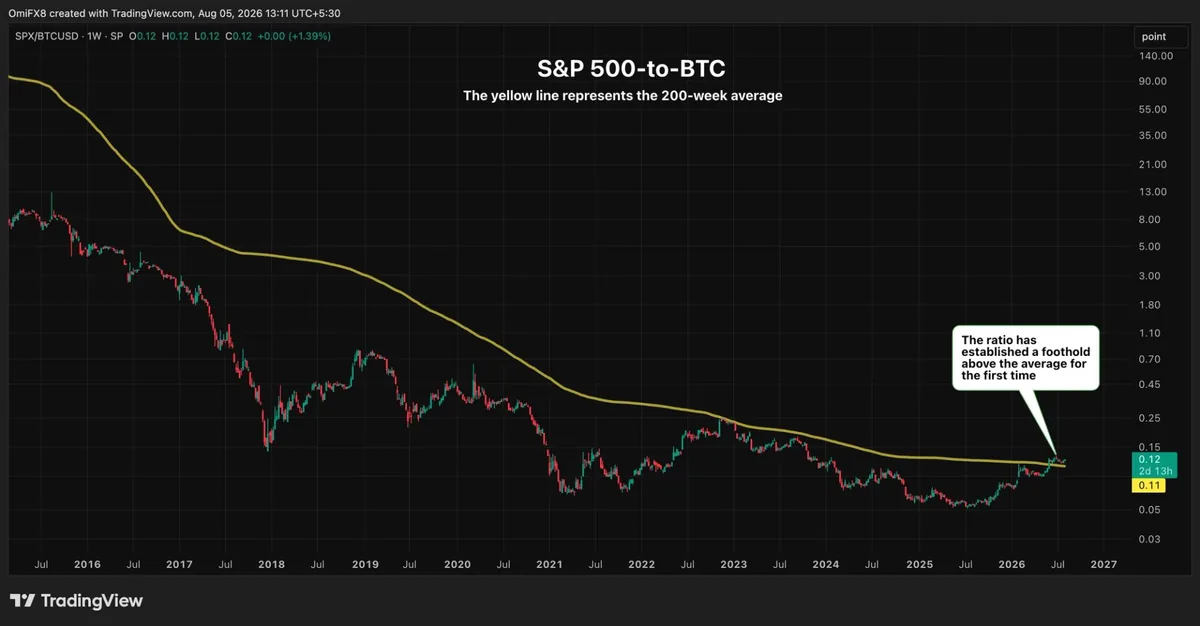
A long-running bitcoin market signal has turned against bulls. According to CoinDesk, the S&P 500-to-bitcoin ratio, which tracks how much BTC is needed to buy the equity index, has climbed above its 200-week moving average for the first time, with the Nasdaq-to-bitcoin ratio showing the same kind of breakout.
The development matters because bitcoin’s historical outperformance versus stocks has been central to its appeal for many supporters. If major U.S. equity indexes can sustain gains against BTC, the argument that bitcoin is uniquely positioned to outperform traditional markets may carry less force for portfolio-focused investors.
CoinDesk noted that the S&P 500-to-bitcoin ratio has fallen dramatically over the long term, from more than 300 BTC in 2012 to roughly 0.12 BTC today. During that period, the 200-week simple moving average generally acted as a ceiling whenever stocks temporarily gained ground against bitcoin.
That pattern has now changed. The ratio has not only moved above the long-term average, but has also held there in recent weeks, making the breakout more notable than earlier, short-lived reversals. The same signal appearing in the Nasdaq-to-bitcoin ratio suggests the move is not limited to one equity benchmark.
The bearish interpretation is that bitcoin’s era of outsized rallies versus equities may be fading, especially as forecasts based on earlier market cycles become harder to justify. A more constructive reading is that bitcoin has matured: with a market value above $1 trillion and deeper infrastructure across spot ETFs, options, futures and structured products, the asset may be easier to access but harder to move sharply.