Bitcoin BIP-110 Fork Stalls After Miners Stay With Original Chain

Bitcoin’s BIP-110 proposal failed to gain broad support, and a fork attempting to enforce its rules produced only two blocks before stalling. The episode showed how Bitcoin’s consensus process and miner incentives can reject disputed changes without a central authority.

Bitcoin BIP-110 Fork Stalls After Miners Stay With Original Chain

What happened?

Bitcoin’s BIP-110 proposal failed to gain broad support, and a fork attempting to enforce its rules produced only two blocks before stalling. The episode showed how Bitcoin’s consensus process and miner incentives can reject disputed changes without a central authority.

Why it matters

Bitcoin’s BIP-110 dispute moved from debate to market test after supporters of the proposal launched a fork from the original Bitcoin chain at block 961,632. The proposal sought to limit non-financial data, including Ordinals inscriptions that some users view as spam, but it did not win broad support in Bitcoin’s open developer process.

Bitcoin’s BIP-110 dispute moved from debate to market test after supporters of the proposal launched a fork from the original Bitcoin chain at block 961,632. The proposal sought to limit non-financial data, including Ordinals inscriptions that some users view as spam, but it did not win broad support in Bitcoin’s open developer process.

The fork’s quick failure matters because it showed Bitcoin governance working through voluntary participation rather than formal enforcement. No regulator or central committee blocked BIP-110; instead, users, developers and miners effectively decided whether to support the proposed rule set by choosing which chain to follow.

According to CoinDesk, miners overwhelmingly stayed with the original Bitcoin network, which remained active and retained virtually all liquidity, activity and security. The BIP-110 chain inherited Bitcoin’s high mining difficulty but attracted only a small amount of hashpower, producing just two blocks before block production stopped.

The episode also highlights the economic side of Bitcoin’s design. Supporters of a rule change were free to launch their own chain, while miners were free to direct computing power toward the chain they considered more profitable. That made the dispute less a formal vote than a live demonstration of incentive-driven consensus.

CoinDesk noted that bitcoin’s spot price continued to trade near $65,000 as traders watched for U.S. inflation data that could influence the next price move. The broader takeaway from the BIP-110 episode is that Bitcoin’s rules are difficult to change without broad coordination across the network’s participants.

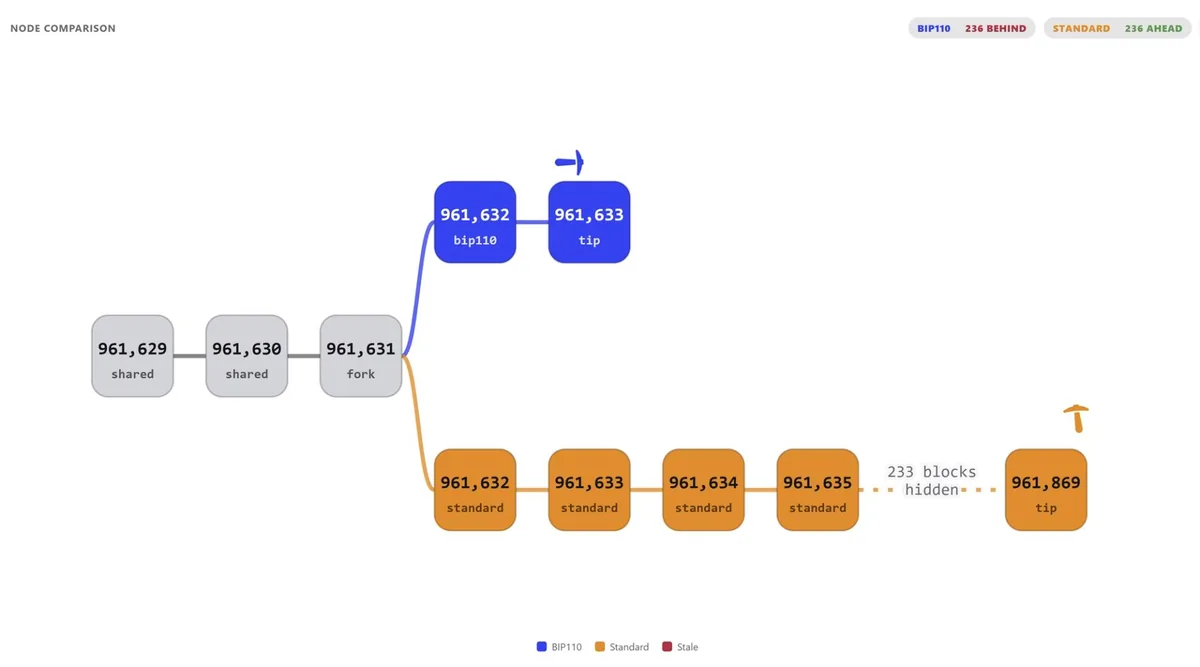
Source: CoinDesk

Keep exploring

Related stories

Australia Suspends Cryptolink Registration Over Reporting Failures

Australia Suspends Cryptolink Registration Over Reporting Failures

Australia’s financial watchdog has suspended Bitcoin ATM operator Cryptolink’s registration for three months over basic reporting failures. The action follows an earlier $56,340 fine against the company.

Read
Bitcoin Climbs Above $65,000 Ahead of U.S. Inflation Report

Bitcoin Climbs Above $65,000 Ahead of U.S. Inflation Report

Bitcoin rose above $65,000 as crypto markets broadly advanced ahead of U.S. inflation data due Wednesday. Traders are watching the report for signs that could shape expectations around Federal Reserve interest rates.

Read
Bitcoin Red Team Founder Returns to Chinese Open-Source AI After OpenAI Access Restriction

Bitcoin Red Team Founder Returns to Chinese Open-Source AI After OpenAI Access Restriction

AnchorWatch CEO Rob Hamilton said OpenAI restricted his access after he began using its Trust & Cyber capabilities for Bitcoin Red Team research. The volunteer effort has identified 1,288 critical and high-level vulnerabilities across Bitcoin-related open-source repositories.

Read