Coldcard Hack Sends Bitcoin Mempool Activity to Highest Level Since 2025

A reported $120 million Coldcard hardware wallet hack that began on July 30 has coincided with a sharp rise in Bitcoin network activity. CoinDesk cited Blockchain.com and Santiment data showing a jump in pending transactions, active addresses and whale transactions, while BTC remained in a tight trading range.

Coldcard Hack Sends Bitcoin Mempool Activity to Highest Level Since 2025

What happened?

A reported $120 million Coldcard hardware wallet hack that began on July 30 has coincided with a sharp rise in Bitcoin network activity. CoinDesk cited Blockchain.com and Santiment data showing a jump in pending transactions, active addresses and whale transactions, while BTC remained in a tight trading range.

Why it matters

Higher network activity is often viewed as supportive for Bitcoin’s valuation, but the price reaction was muted in the period covered by the report. CoinDesk said bitcoin remained within its recent $62,000 to $65,000 range rather than making a major move in either direction.

A reported $120 million hack involving the Coldcard hardware wallet has pushed fresh attention onto Bitcoin’s on-chain activity. According to CoinDesk, the incident began on July 30 and was still in progress when the report was published, raising renewed questions about self-custody and hardware wallet security.

The development matters because it appears to have prompted holders to move coins between exchanges and multiple wallets. That activity showed up in Bitcoin’s memory pool, or mempool, where transactions wait before miners confirm them on-chain.

CoinDesk cited Blockchain.com data showing the number of pending Bitcoin transactions climbed to 89,031 on Tuesday, the highest level since February 2025. Santiment data pointed in the same direction, with active addresses reaching a three-month high of 712,000 and transactions by large holders, often called whales, rising to a five-month high of 61,800.

Higher network activity is often viewed as supportive for Bitcoin’s valuation, but the price reaction was muted in the period covered by the report. CoinDesk said bitcoin remained within its recent $62,000 to $65,000 range rather than making a major move in either direction.

Analysts cited by CoinDesk were still watching broader catalysts, including the fate of the Clarity Act and U.S. real yields. Marex analysts described the legislation as the near-term policy variable, while Bitfinex noted that the bullish macro case for bitcoin could weaken if the real yield on the 10-year U.S. Treasury note moved above 2.5%.

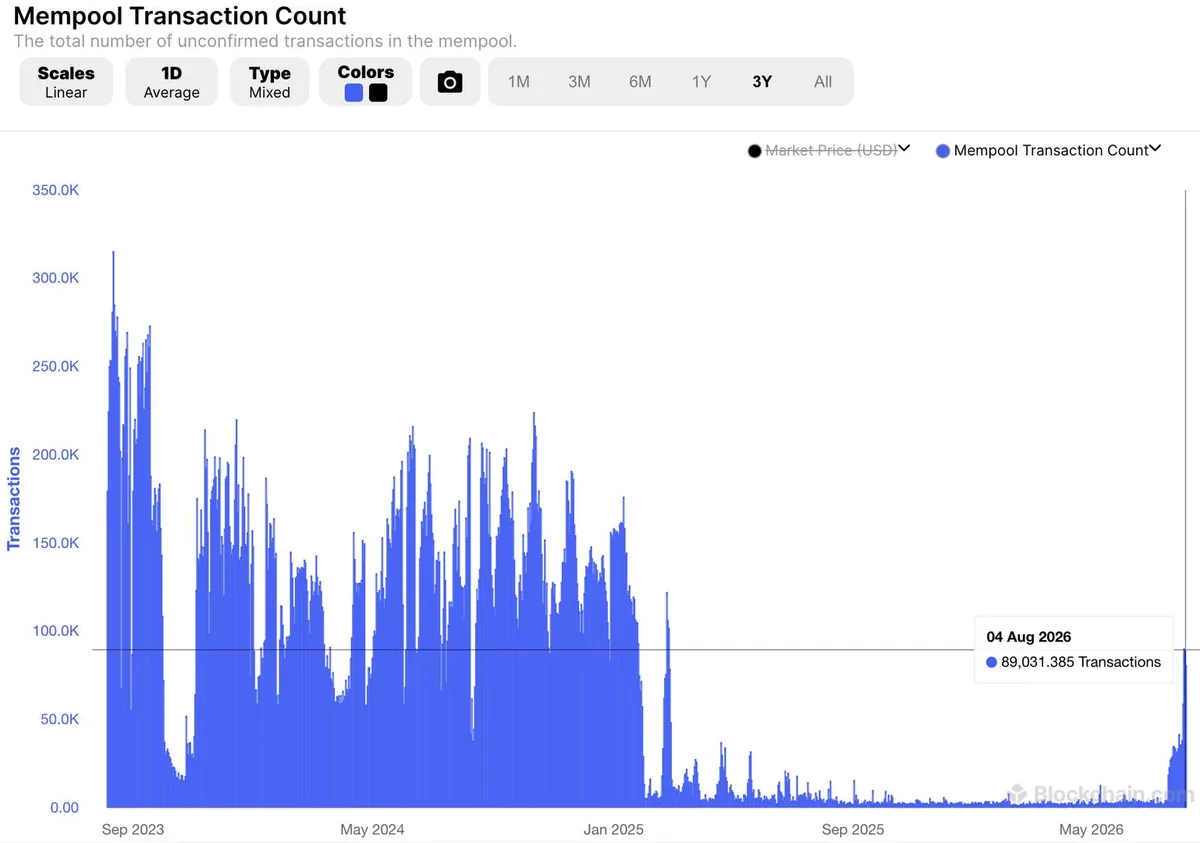
Source: CoinDesk

Keep exploring

Related stories

Bitwise CIO Says Crypto Momentum Does Not Depend on CLARITY Act

Bitwise CIO Says Crypto Momentum Does Not Depend on CLARITY Act

Bitwise’s Matt Hougan says crypto can keep advancing even if Congress does not pass major market structure legislation this year. He argues that guidance from the SEC and CFTC would still give the industry room to move forward.

Read
Ethereum Researchers Propose Staking Reward Burn as Staked ETH Nears Key Threshold

Ethereum Researchers Propose Staking Reward Burn as Staked ETH Nears Key Threshold

A draft Ethereum proposal would gradually burn a larger share of newly issued validator rewards as staking rises, reaching a full burn when roughly 60.25 million ETH is staked. The idea is intended to curb excessive staking, but it has already drawn pushback from DeFi and liquid staking participants.

Read
Arthur Hayes Says AI Credit Boom Could Push Bitcoin Past $1 Million

Arthur Hayes Says AI Credit Boom Could Push Bitcoin Past $1 Million

Arthur Hayes compared the debt-funded buildout of AI infrastructure to the credit excesses that preceded the 2008 crisis. He argued the cycle could support a Bitcoin “crack-up boom,” while the available evidence points to uneven financial pressure across major technology firms.

Read