Software Stocks Pull Ahead of Bitcoin as Long-Running Link Weakens

Software stocks have broken away from bitcoin, with the iShares Expanded Tech-Software Sector ETF reaching a one-year high against BTC. The move matters because bitcoin has often traded like a software-linked risk asset, but the latest divergence raises questions about whether that relationship is changing.

Software Stocks Pull Ahead of Bitcoin as Long-Running Link Weakens

What happened?

Software stocks have broken away from bitcoin, with the iShares Expanded Tech-Software Sector ETF reaching a one-year high against BTC. The move matters because bitcoin has often traded like a software-linked risk asset, but the latest divergence raises questions about whether that relationship is changing.

Why it matters

Software stocks are outperforming bitcoin in a rare market divergence. The iShares Expanded Tech-Software Sector ETF, known as IGV, has climbed to a one-year high relative to bitcoin, with the ratio reaching 0.0016, according to CoinDesk.

Software stocks are outperforming bitcoin in a rare market divergence. The iShares Expanded Tech-Software Sector ETF, known as IGV, has climbed to a one-year high relative to bitcoin, with the ratio reaching 0.0016, according to CoinDesk.

The shift matters because bitcoin and IGV had moved largely together for years, reflecting how markets often treated bitcoin as a software-like risk asset. That relationship began to weaken in May, and the 20-day rolling correlation between the two has turned negative for the first time since May 2024.

The performance gap is wide. IGV is now down only 1% in 2026 after rallying 40% from its April low, when concerns over an AI-driven “SaaS apocalypse” weighed on the sector. Bitcoin, by contrast, is down 29% this year and remains about 50% below its all-time high, while IGV is just 13% under its own record.

CoinDesk noted that bitcoin had been pulled into the earlier software selloff after IGV fell 40% from its fourth-quarter 2025 peak. The current rebound in software shares therefore marks a notable break from a pattern that had linked the two assets through several market cycles.

History gives bitcoin bulls some precedent, but not certainty. Similar negative-correlation periods appeared during the 2018 bitcoin bear market, the 2020 Covid shock and China’s bitcoin mining ban in summer 2021, and each was followed by bitcoin catching up as correlation turned positive again. The open question now is whether this episode follows that path or signals a more durable split between digital assets and technology equities.

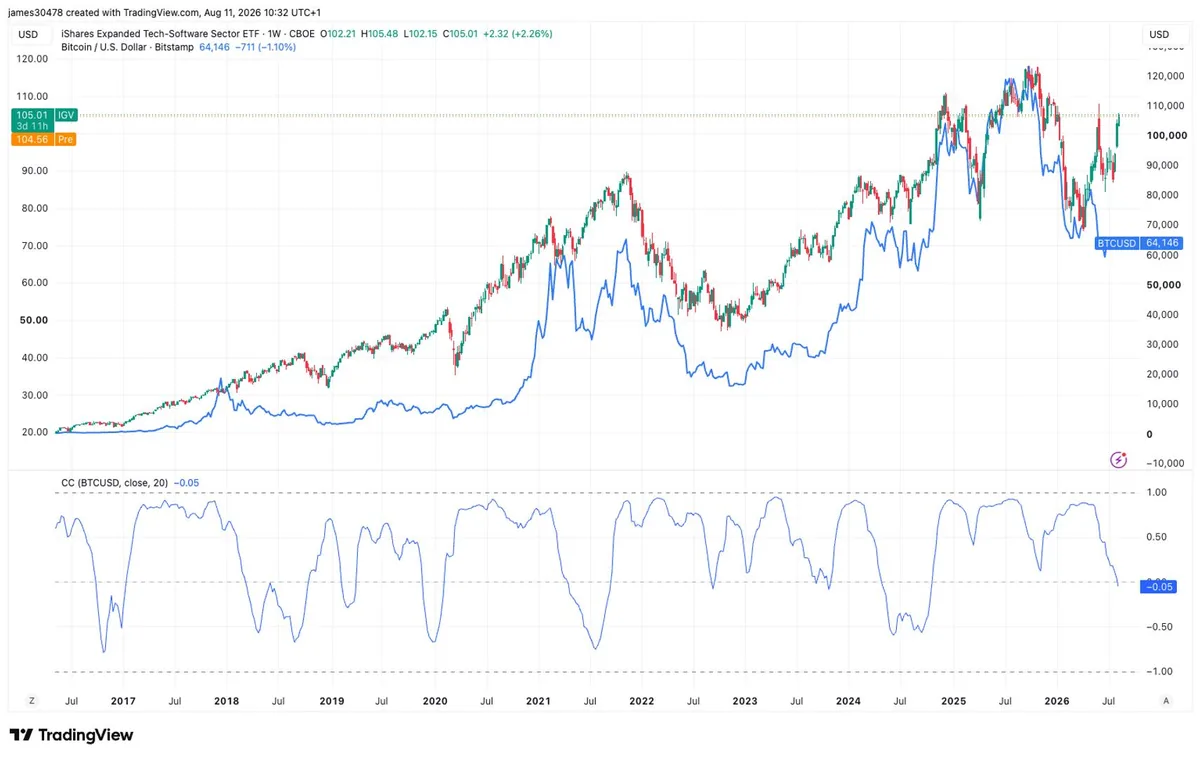
Source: CoinDesk

Keep exploring

Related stories

Wintermute Wins U.S. Broker-Dealer Status as Crypto and Wall Street Converge

Wintermute Wins U.S. Broker-Dealer Status as Crypto and Wall Street Converge

Wintermute’s U.S. arm has registered with the SEC and joined FINRA, giving the crypto market maker broker-dealer status for institutional operations. The approval lets the firm trade U.S. stocks and options, support ETF liquidity and pursue a larger role in crypto-linked traditional markets.

Read
CLARITY Act Delay Could Give Asian Crypto Hubs an Opening, First Digital CEO Says

CLARITY Act Delay Could Give Asian Crypto Hubs an Opening, First Digital CEO Says

Industry figures warned that prolonged uncertainty around the CLARITY Act could slow institutional crypto adoption in the United States. They said the delay may also revive regulation by enforcement and push more innovation offshore.

Read
Stripe-Owned Bridge Enters EU MiCA Register After Luxembourg Approval

Stripe-Owned Bridge Enters EU MiCA Register After Luxembourg Approval

Stripe-owned Bridge has joined the European Union’s MiCA register after receiving approval in Luxembourg. The move places Bridge among regulated providers operating under the bloc’s crypto framework.

Read