Vitalik Buterin Says Ethereum’s Roadmap Is Focused on Quantum Security and AI

Ethereum’s updated roadmap places quantum resistance, privacy and AI-assisted formal verification at the center of its technical priorities. The direction signals a long-term focus on making the network more resilient as cryptography and software verification challenges evolve.

Vitalik Buterin Says Ethereum’s Roadmap Is Focused on Quantum Security and AI

What happened?

Ethereum’s updated roadmap places quantum resistance, privacy and AI-assisted formal verification at the center of its technical priorities. The direction signals a long-term focus on making the network more resilient as cryptography and software verification challenges evolve.

Why it matters

The update matters because Ethereum remains one of crypto’s most important infrastructure networks, supporting applications, companies and users across the ecosystem. A roadmap that emphasizes security, privacy and verification points to work aimed at strengthening the base layer for long-term use.

Ethereum’s updated roadmap puts quantum resistance, privacy and AI-assisted formal verification at the center of the network’s technical ambitions, according to Decrypt. Vitalik Buterin framed these areas as key priorities for Ethereum’s future development.

The update matters because Ethereum remains one of crypto’s most important infrastructure networks, supporting applications, companies and users across the ecosystem. A roadmap that emphasizes security, privacy and verification points to work aimed at strengthening the base layer for long-term use.

Quantum resistance refers to preparing cryptographic systems for a future in which quantum computing could challenge today’s security assumptions. By highlighting that area, Ethereum’s roadmap is focused not only on current network demands but also on risks that could become more important over time.

Privacy is also part of the technical agenda, reflecting an ongoing concern for public blockchains where activity is visible by default. The roadmap’s inclusion of privacy suggests Ethereum developers continue to weigh how the network can support transparency while improving user protections.

AI-assisted formal verification adds another layer to the roadmap. Formal verification is used to check whether software behaves as intended, and applying AI to that process could help Ethereum’s technical community test and reason about complex systems more effectively.

Source: Decrypt

Keep exploring

Related stories

Bitcoin BIP-110 Fork Stalls After Miners Stay With Original Chain

Bitcoin BIP-110 Fork Stalls After Miners Stay With Original Chain

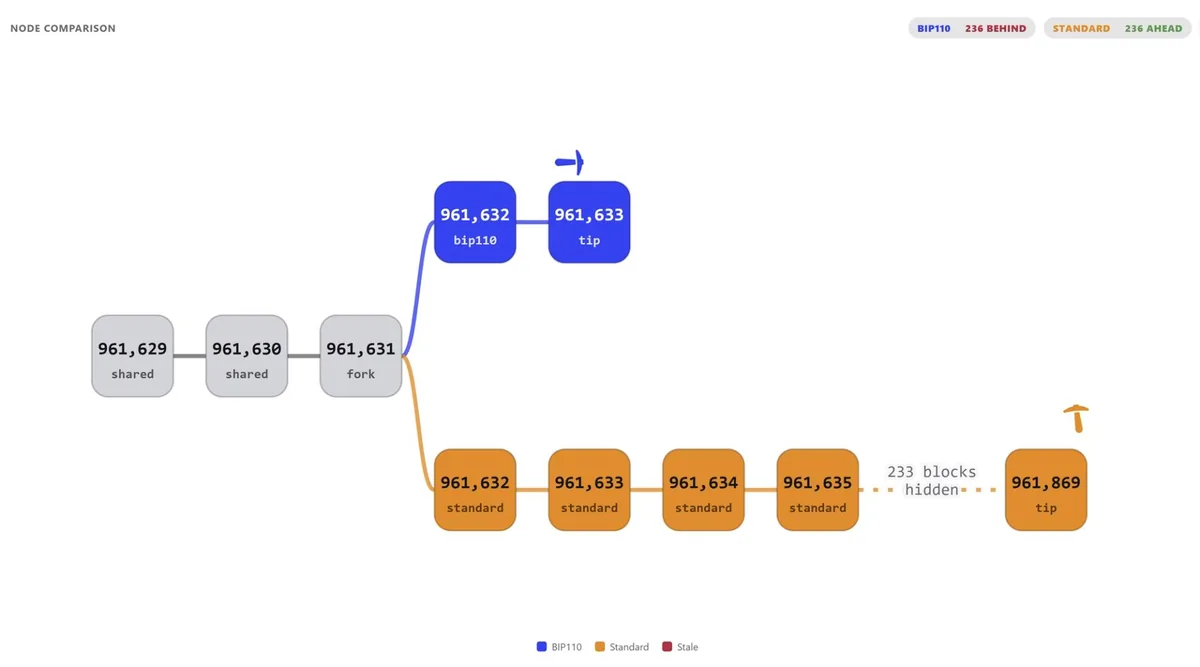
Bitcoin’s BIP-110 proposal failed to gain broad support, and a fork attempting to enforce its rules produced only two blocks before stalling. The episode showed how Bitcoin’s consensus process and miner incentives can reject disputed changes without a central authority.

Read
UK FCA Prepares Tokenized Gold Rules to Support London Bullion Market

UK FCA Prepares Tokenized Gold Rules to Support London Bullion Market

The U.K. Financial Conduct Authority is working on rules for tokenized gold as part of a wider digital asset strategy. The effort is aimed at exploring how blockchain-based claims on physical bullion could fit into wholesale markets while London faces growing competition as a global gold trading hub.

Read
Standard Chartered Says RWA Growth Could Lift Chainlink’s LINK to $200 by 2030

Standard Chartered Says RWA Growth Could Lift Chainlink’s LINK to $200 by 2030

Standard Chartered reportedly expects Chainlink’s LINK token to reach $200 by the end of 2030 if tokenized real-world assets expand to $4 trillion. The forecast is tied to potential demand for Chainlink’s oracle services as the RWA market grows.

Read