Bitcoin Lags as U.S. Stocks Add Trillions in Market Value

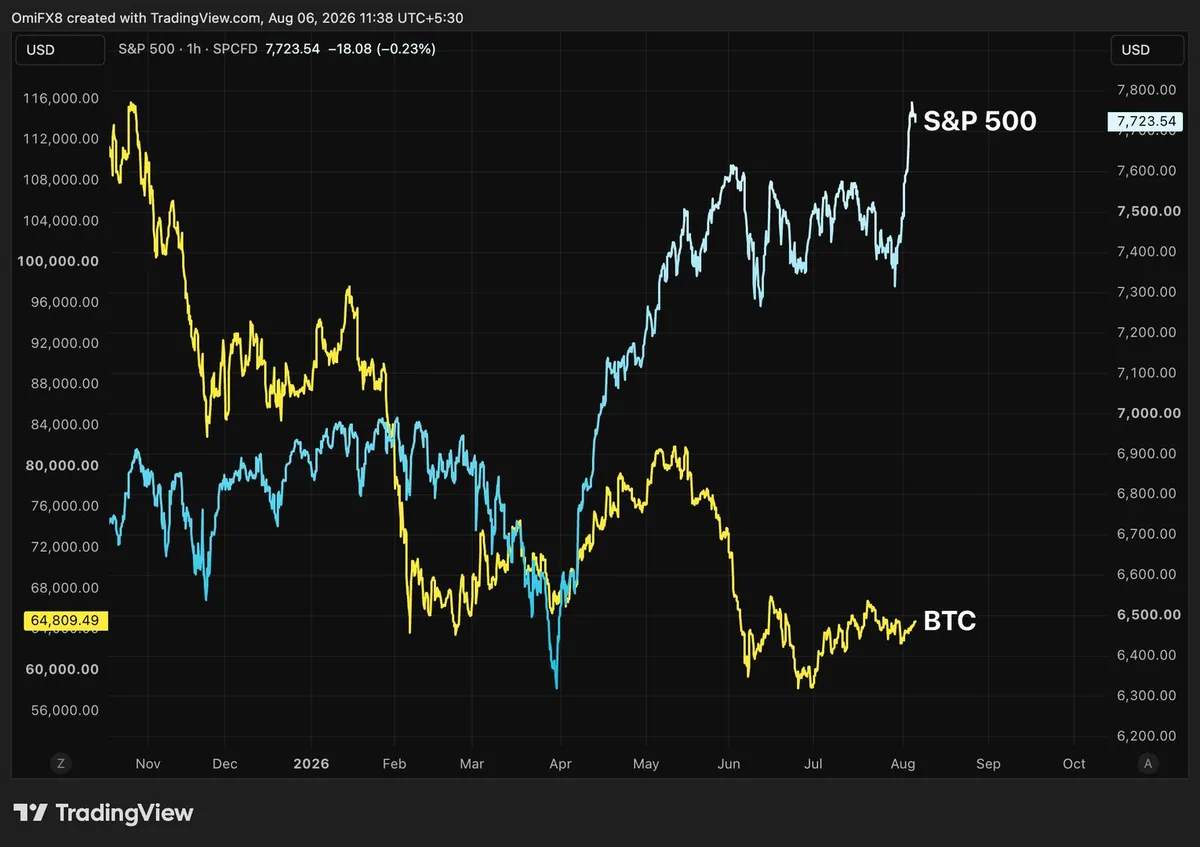
The S&P 500 has gained 3.12% this month, adding about $2.1 trillion in market value, while bitcoin has risen only 2%. Analysts cited an AI-led stock rally, crypto-specific sentiment pressures, uneven ETF demand and cycle-based positioning as reasons for the gap.

Bitcoin Lags as U.S. Stocks Add Trillions in Market Value

What happened?

The S&P 500 has gained 3.12% this month, adding about $2.1 trillion in market value, while bitcoin has risen only 2%. Analysts cited an AI-led stock rally, crypto-specific sentiment pressures, uneven ETF demand and cycle-based positioning as reasons for the gap.

Why it matters

The S&P 500 has climbed 3.12% this month, adding roughly $2.1 trillion in market capitalization and lifting its total value to a record $70.5 trillion, according to CoinDesk. Bitcoin has not matched that momentum, rising just 2% over the same period and trading around $64,600, a level it had already reached in July.

The S&P 500 has climbed 3.12% this month, adding roughly $2.1 trillion in market capitalization and lifting its total value to a record $70.5 trillion, according to CoinDesk. Bitcoin has not matched that momentum, rising just 2% over the same period and trading around $64,600, a level it had already reached in July.

The divergence matters because bitcoin has often moved in line with equities since the market shock of early 2020. This time, analysts said the stock rally appears concentrated in artificial intelligence and semiconductor-related shares, rather than reflecting a broad risk-on move that would automatically pull crypto assets higher.

Tesseract Group’s Adam Haeems told CoinDesk that lower oil prices and hopes for normalized flows through the Strait of Hormuz may support risk assets, but the transmission is more direct for equities through lower business costs. For bitcoin, he said, the potential effect would work through inflation expectations and Federal Reserve policy, which takes longer and remains uncertain.

Crypto is also dealing with its own market pressures. CoinDesk cited the $120 million Coldcard exploit, uncertainty around the Clarity Act, reports involving Strategy’s bitcoin sales, higher bond yields and falling stablecoin supply as factors weighing on sentiment. Haeems said USDT supply had fallen from about $190 billion in April to $183 billion, while USDC declined from $79.5 billion to $72 billion.

Positioning may be another reason traders are hesitant. Markus Thielen of 10x Research said many bitcoin traders are waiting for a possible October bottom based on the four-year halving cycle, while other analysts pointed to inconsistent demand for U.S.-listed spot bitcoin ETFs. Those funds recently posted a $61.53 million outflow before drawing $626 million this week, but market watchers said several days of sustained inflows would be needed to confirm stronger institutional demand.

Source: CoinDesk

Keep exploring

Related stories

CASHCAT Rebounds as Robinhood Chain TVL Reaches $774 Million

CASHCAT Rebounds as Robinhood Chain TVL Reaches $774 Million

CASHCAT rose 120% over the past week, recovering part of its post-launch decline while Robinhood Chain’s total value locked climbed to $774 million. The move comes as broader launchpad activity has cooled and the chain’s next test approaches: whether usage holds once Robinhood stops covering gas fees.

Read
XRP Whales Accumulate as Ether Holders Face Deeper Losses

XRP Whales Accumulate as Ether Holders Face Deeper Losses

CryptoQuant data cited by CoinDesk shows large XRP holders kept buying during the token’s decline, even as the market stayed rangebound. Ether showed a stronger capitulation signal because it traded below its realized price, leaving holders underwater on paper.

Read
Bitcoin Holds Above $64,600 as SpaceX Stock Unlock Draws Attention

Bitcoin Holds Above $64,600 as SpaceX Stock Unlock Draws Attention

Bitcoin traded just above $64,600 on Thursday while major crypto tokens were mixed. Traders also watched a large SpaceX stock unlock and a softer global equity backdrop tied partly to weakness in chipmakers.

Read