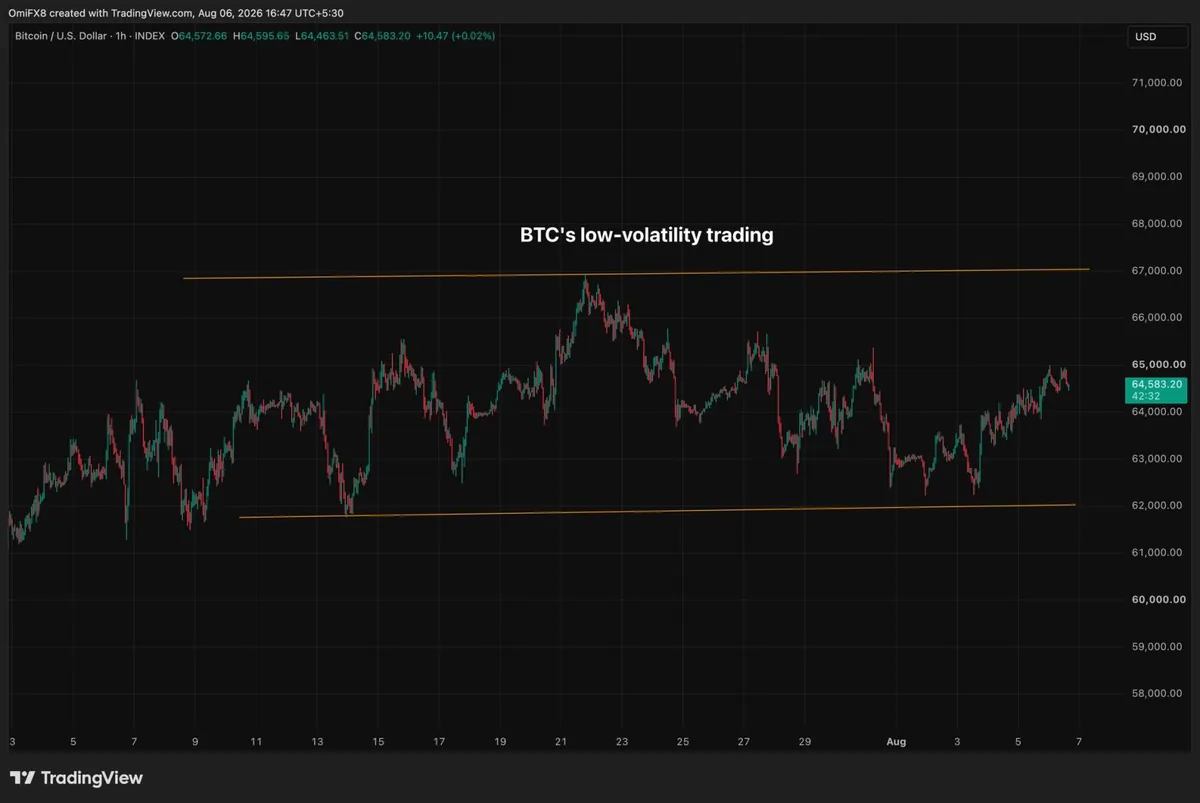
Bitcoin has been unusually steady while broader risk assets have moved more sharply, with CoinDesk reporting that BTC’s 30-day implied volatility has dropped to a long-held floor of 36%. The calmer trading has stood out because bitcoin has not meaningfully joined the risk-on rally seen in stocks and remains choppy below $65,000.
That matters because low volatility can be misread as low risk. In derivatives markets, cheaper volatility can lower the cost of directional positions and hedges, allowing traders to build larger exposures. If price then moves through levels where positioning is concentrated, market makers may need to adjust their books in ways that add momentum to the move.
Tesseract Group’s Adam Haeems told CoinDesk that low volatility should not be confused with safety, particularly when leverage is involved and when trading volumes and market depth are subdued. The point is less that a sharp move is guaranteed, and more that quiet markets can store risk when positioning becomes crowded.
Options signals also suggest hesitation rather than conviction. Paul Howard of Wincent said demand for puts, or downside protection, has weakened, while strong bids for upside exposure are also lacking. Glassnode described the setup as a market where traders are not paying much for either calls or puts.
CoinDesk noted possible catalysts on both sides. Positive regulatory developments around the Clarity Act could support institutional ETF inflows, while a breakdown in Hormuz-related talks or an inflation shock could work the other way. For now, bitcoin’s subdued volatility is a sign of calm trading conditions, not proof that market risk has disappeared.